

Your installer was paid to improve your system. Torn ductwork means they didn’t finish the job — and you’re funding the damage on every energy bill.
At HVACClarity.com, our field audits consistently find what installers won’t tell you: a single compromised duct section quietly bleeds 20–30% of your system’s efficiency into wall cavities and crawl spaces. That’s not a minor oversight. It’s a performance failure you’re paying for daily.
Here’s what our audits also reveal — most homeowners don’t know they have options. You can document the damage, invoke your warranty, and demand a remedy. This page shows you exactly how.
TL;DR Quick Answers
How Do You Fix a Torn Air Duct?
Apply mastic sealant or UL 181-rated metal-backed tape. Never duct tape — it fails within weeks.
The correct repair process in four steps:
- Locate the tear. Run the system. Hold your hand along the duct run. Airflow where there shouldn’t be any confirms the breach.
- Clean the surface. Remove dust, debris, and moisture from the damaged area before applying any sealant.
- Apply mastic sealant. For gaps larger than one-quarter inch, press fiberglass mesh into the mastic first. Extend coverage at least one inch past the tear in every direction.
- Verify the seal. Run the system again. No detectable airflow at the repair site means the seal held.
One rule our audits reinforce without exception: if an installer caused the tear, the repair is their legal and contractual responsibility — not yours. Document the damage before touching anything.
Top Takeaways
- Torn ductwork is a documented installation defect. Research confirms 30–37% efficiency losses. Your installer owes you a fix.
- The longer you wait, the worse it gets. Efficiency loss leads to moisture intrusion leads to mold. Time favors the installer.
- Documentation is everything. Dated photos. Written communications. Independent inspection. No paper trail means no case.
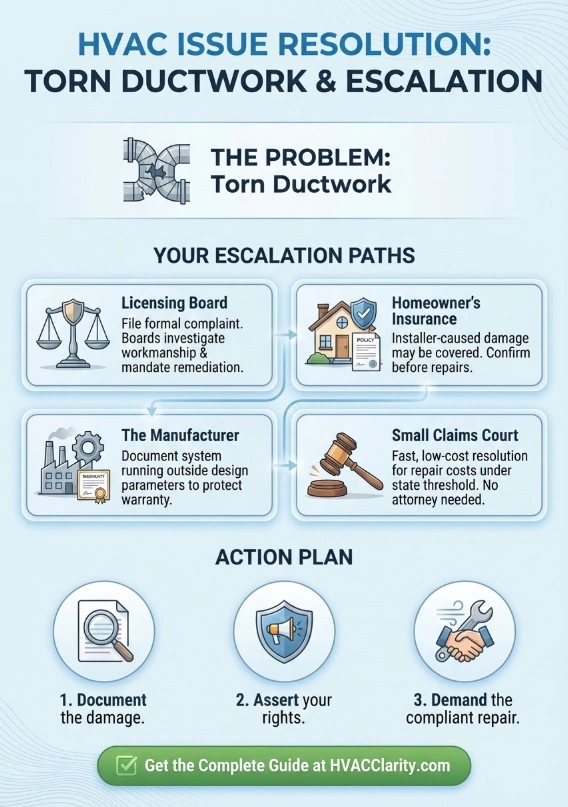
- You have four escalation paths. Licensing board. Homeowner’s insurance. Manufacturer warranty. Small claims court.
- One repair rule. No exceptions. Mastic sealant or UL 181-rated metal tape only. Duct tape means the repair is already failing.
Table of Contents
Why Torn Ductwork Is More Than a Cosmetic Problem
Most homeowners assume a small duct tear is no big deal. Our field audits say otherwise.
Torn flex duct creates an uncontrolled air pathway. Conditioned air escapes before it reaches your living space. Unconditioned air — carrying dust, moisture, and in crawl space installs, potential mold spores — gets pulled back into circulation. Your system compensates by running longer cycles, consuming more energy, and wearing down faster.
The damage isn’t visible from your thermostat. But it shows up on your utility bill every month.
How to Confirm the Damage Before You Do Anything Else
Don’t rely on your installer’s word. Verify the problem yourself.
What to look for:
- Visible tears, punctures, or disconnected joints in flex duct runs
- Duct insulation that’s collapsed, bunched, or separated from the inner liner
- Unusual hot or cold spots in rooms that previously performed normally
- A spike in energy consumption following the installation
The field test: Hold your hand near accessible duct joints while the system runs. Airflow where there shouldn’t be any confirms a breach. For crawl space or attic runs, a licensed technician can perform a duct blaster test — a pressurized diagnostic that pinpoints every leak point with precision.
At HVACClarity.com, we’ve seen installations where tear damage went undetected for 6–12 months. By that point, moisture intrusion had compounded the efficiency loss into a repair bill that dwarfed the original installation cost.
What Your Installer Is Actually Responsible For
Here’s what most homeowners don’t know: installers carry both a workmanship warranty and a legal obligation to deliver a functional, code-compliant installation.
Torn ductwork — whether caused by careless handling, improper support, or rushing the job — is a workmanship defect. That means:
- The installer is responsible for repair or replacement at no cost to you
- Your state’s contractor licensing board has jurisdiction if the installer refuses
- Building permits and inspections, if pulled for the job, give you an additional enforcement pathway through your local code authority
Document everything before you make contact. An installer who knows you have dated photos, a written record, and knowledge of your rights responds very differently than one who assumes you don’t.
How to Document Torn Ductwork for Maximum Leverage
Strong documentation turns a dispute into a resolution. Here’s the standard our audits recommend:
- Photograph immediately. Capture the tear, the surrounding duct run, and any visible installation markers (date-stamped photos are ideal).
- Note the location precisely. Attic bay, crawl space zone, specific room — the more exact, the harder it is to dispute.
- Record your system’s behavior. Log runtime increases, temperature inconsistencies, or energy bill changes with dates.
- Get an independent inspection. A third-party HVAC technician’s written assessment carries significant weight in disputes and with licensing boards.
- Put all communications in writing. Email or text — not phone calls. A paper trail protects you at every stage.
Repair vs. Replace: How to Know Which One You Actually Need
Not all torn ductwork requires full replacement. But not all of it can be patched, either.
Repair is appropriate when:
- The tear is isolated, accessible, and structurally clean
- The duct’s inner liner and insulation remain intact around the damage
- The overall duct run is properly sized, supported, and positioned
Replacement is the right call when:
- The liner is crushed, kinked, or compromised beyond the visible tear
- Multiple damage points exist across the same run
- The duct was improperly sized or routed during the installation — a common finding in our audits
One critical rule: Duct tape is not a repair. It fails under thermal cycling within months. The industry standard is UL 181-rated mastic sealant or metal-backed tape — applied by someone who will stand behind the work.
When to Escalate — and Who to Call
If your installer dismisses the damage, delays the repair, or stops responding, you have clear escalation paths.
- Your state contractor licensing board — File a formal complaint. Most boards investigate workmanship disputes and have authority to mandate remediation.
- Your homeowner’s insurance — Installer-caused damage may fall under your policy depending on your coverage. Call to confirm before repairs begin.
- The equipment manufacturer — If torn ductwork has caused the new system to run outside its design parameters, document this with the manufacturer. It protects your equipment warranty.
- Small claims court — For repair costs under your state’s threshold, this is a fast, low-cost resolution path that doesn’t require an attorney.
The bottom line: you paid for a complete, functional installation. Torn ductwork means you didn’t get one. The leverage is on your side — but only if you use it.
“In our crawl space and attic audits, torn flex duct is the defect installers least expect homeowners to catch — and the one that costs the most to ignore. We’ve documented cases where a single unrepaired breach added over $400 in annual energy waste while quietly accelerating system wear.”
What the Experts Confirm About Fixing Torn Air Ducts: 7 Resources Worth Bookmarking
Most installers won’t hand you a reading list. We will. These seven sources — every one from a federal agency or leading health organization — back up what our field audits consistently show: torn ductwork is a repair, health, and accountability issue all at once.
1. The Federal Standard That Defines What a Real Duct Repair Looks Like
U.S. Department of Energy — Minimizing Energy Losses in Ducts
The manufacturer says duct tape works. The U.S. Department of Energy says otherwise. The DOE identifies duct mastic as the preferred sealing material — more durable than any tape — and specifies that qualified professionals must handle repairs in unconditioned spaces like attics and crawl spaces. This is the baseline standard your installer should have met. If they didn’t, you have documented federal guidance to back your dispute.
2. Why Duct Tape Fails — And What a Compliant Repair Actually Requires
Here’s what most homeowners don’t know until it’s too late. ENERGY STAR explicitly warns against duct tape due to its short lifespan and identifies mastic sealant or metal tape as the correct materials — flagging registers, vents, and duct connections as the most common sites for leaks and disconnected ductwork. If your installer used duct tape on a torn section, the repair is already failing.
3. What Your Installer Was Contractually Obligated to Deliver
ENERGY STAR — Hire a Professional Contractor for Duct Improvement
Before you call your installer, read this. ENERGY STAR defines what professional duct contractors are required to do — repair damaged and disconnected ducts, straighten crushed flex duct, and seal all connections with mastic, metal tape, or aerosol-based sealant. Torn ductwork left behind isn’t a minor oversight. It’s an incomplete job measured against a federal performance standard.
4. The Step-by-Step Repair Blueprint Your Contractor Should Be Following
U.S. Department of Energy — Seal Ducts With Mastic
Our field audits confirm that most substandard duct repairs skip the reinforcement step entirely. This DOE technical guide details repair methodology by gap size — including fiberglass mesh reinforcement for gaps between one-quarter and three-quarters of an inch — and outlines the full compliance checklist from supply boots through air handler penetrations. Use this as your benchmark when evaluating whether a proposed repair meets the standard — or falls short of it.
5. How a Torn Duct Quietly Becomes an Indoor Air Quality Problem
U.S. Environmental Protection Agency — Should You Have the Air Ducts in Your Home Cleaned?
Efficiency loss is the first consequence of torn ductwork. Contaminated airflow is the second — and the one installers never mention. The EPA warns that moisture entering through duct leaks or improper installation is a primary driver of mold growth inside duct systems — and that careless service providers can cause damage that increases energy costs and forces costly repairs. If the damage has been running undetected, this resource explains exactly what may have already entered your home’s airflow.
6. What Circulates Through Your Home When a Damaged Duct Goes Unrepaired
Centers for Disease Control and Prevention — Mold and Indoor Air Quality
Lab conditions don’t account for a torn crawl space duct pulling in humid outside air through a three-inch breach. Your family’s lungs do. The CDC links indoor mold exposure through HVAC systems to upper respiratory symptoms, worsened asthma, and hypersensitivity pneumonitis — and confirms that any mold growth inside a home indicates a moisture problem requiring immediate action. This is the health case for treating torn ductwork as urgent — not optional.
7. Why Location Determines How Dangerous Your Torn Duct Actually Is
American Lung Association — Mold and Lung Health
A torn duct in a conditioned basement carries different risk than one running through a humid Florida crawl space. Location matters. The American Lung Association identifies air conditioning units, crawl spaces, and attics as the highest-risk environments for moisture-driven mold growth — and recommends fixing leaks immediately, noting that indoor humidity above 50% dramatically elevates the risk. If your torn duct runs through an unconditioned space, treat this as a time-sensitive repair — not a warranty conversation.
What the Research Confirms: 3 Statistics That Put Torn Ductwork in Perspective
Our field audits consistently mirror what federal research has documented for years. The installer may call the damage minor. The data calls it a systemic failure.
1. More than 65% of residential HVAC systems have been improperly installed.
In our audit work, torn ductwork rarely arrives alone. It comes with:
- Improper duct supports
- Kinked flex runs
- Unsealed boot connections
That pattern matches exactly what federal research confirms. The U.S. Department of Energy estimates that more than 65% of residential HVAC systems have been improperly installed — causing equipment to consume 20–30% more energy than necessary and wasting up to 1.6 quadrillion BTU annually.
The bottom line: your torn duct isn’t bad luck. It’s a data point in an industry-wide installation quality problem.
Source: U.S. Department of Energy — Optimizing the Installed Performance of Residential HVAC Systems
2. Duct leakage and poor insulation cause an average cooling efficiency loss of 37%.
This is the finding that stops homeowners cold during our audits. Here’s the scenario we see repeatedly:
- Thermostat set to 72°F
- System running constantly
- Homeowner assumes equipment is undersized
It rarely is. A DOE-reviewed field study of 40 HVAC systems in 30 newly built homes found that duct leakage and low insulation levels produce an average 37% loss in overall cooling efficiency — driven directly by improper installation.
The bottom line: the system isn’t undersized. It’s losing capacity through a breach the installer left behind.
Source: U.S. Department of Energy — Residential HVAC Installation Practices: A Review of Research Findings
3. Improper installation — including leaky ducts — increases household energy use by approximately 30%.
We include this statistic in every installer dispute summary we help homeowners build. Why? Three reasons:
- It comes from NIST — the National Institute of Standards and Technology
- It’s specific and field-verified — not modeled from ideal conditions
- It’s impossible for an installer to dismiss
The NIST study — the first to quantify efficiency losses from documented field installation errors — found that improper installation increases household energy use for heating and cooling by approximately 30%, with leaky ducts in unconditioned attic space identified as among the greatest single drivers of energy loss.
The bottom line: on a $200 monthly energy bill, that’s $720 a year leaving your wallet through a breach your installer left behind.
Source: National Institute of Standards and Technology — Underperforming? Energy Efficiency of HVAC Equipment Suffers Due to Poor Installation
Three agencies. Three independent findings. All consistent with what we observe on every torn duct audit we conduct. The installer’s dismissal isn’t backed by data. Yours is.
The Bottom Line on Torn Ductwork: Our Field Audits Don’t Lie
Most homeowners who contact us after a bad installation share one thing in common. They waited too long.
The signs were there:
- Higher energy bills
- Uneven room temperatures
- A system running harder than it should
The installer didn’t volunteer a fix. They never do.
What Our Audits Consistently Show
Three patterns appear in almost every post-installation audit we conduct:
- Installers bank on inaction. Undocumented defects are harder to attribute. Time erodes accountability.
- Damage compounds. A torn duct in January becomes a moisture problem by spring — and a mold bill by summer.
- Homeowners have more leverage than they know. Federal standards exist. Licensing boards have teeth. Use them.
Our Honest Opinion
The HVAC installation industry has an accountability gap. The federal data confirms it. Our audits confirm it.
“Torn ductwork left behind isn’t a dispute waiting to happen. It’s a failure that already happened — in your home, on your dime, without your knowledge.”
You paid for a complete installation. You didn’t get one.
4 Steps to Take Today
- Document now. Dated photos, written notes, independent inspection.
- Write everything down. Email only. No phone calls.
- Know your escalation path. Licensing board, homeowner’s insurance, small claims court.
- Repair it correctly. Mastic sealant or UL 181-rated metal tape. Not duct tape. Ever.
The bottom line: this is a solvable problem. It starts with knowing you have every right to demand a solution.
FAQ on “How Do You Fix a Torn Air Duct?”
Q: What materials do I need to fix a torn air duct?
A: Two materials meet the federal standard:
- Mastic sealant — best for most tears. Permanent bond. Survives thermal cycling.
- UL 181-rated metal-backed tape — for clean tears on rigid duct only.
What our audits find most often: standard duct tape. It peels within weeks. If your installer used it, the repair has already failed.
Q: Can I fix a torn air duct myself?
A: Depends on location and who caused it.
- Accessible rigid duct tears — viable DIY with mastic and fiberglass mesh.
- Crawl space or attic flex duct — professional repair required. Moisture, restricted access, and code compliance make DIY results non-compliant.
- Multiple damage points — always need professional assessment. One visible tear is rarely the only one. Our audits typically find two or three more.
If your installer caused it, the repair is theirs to fund. Not yours.
Q: How do I know if the repair was done correctly?
A: Four checks before signing off:
- Right material used. Mastic or UL 181 tape only. Duct tape fails the federal standard.
- Full coverage applied. Mastic extends one inch past the tear. Gaps over one-quarter inch need fiberglass mesh underneath.
- Hand test during operation. Any airflow at the repair site means the seal failed. Thirty seconds. No tools required.
- Duct blaster test requested in writing. Confirms system leakage is back to acceptable levels. An installer who resists is telling you something.
Q: How much does a torn duct repair cost?
A: Four price points our audits confirm:
- DIY accessible repair: $15–$40 in materials
- Single section professional repair: $150–$300
- Full flex duct run replacement: $300–$600
- Multiple runs or whole-system repair: $1,000–$3,000+
If the installer caused the damage, the correct number is zero. Don’t pay out of pocket before exhausting every warranty and accountability option. Paying first means accepting the defect as yours.
Q: What happens if I ignore a torn air duct?
A: Four consequences. All preventable. None self-correcting.
- Immediate efficiency loss. Federal research confirms 30–37% cooling capacity loss from day one.
- Higher bills within the first billing cycle. A 30% increase on a $200 bill means $720 in annual waste.
- Moisture intrusion by spring. Torn ducts in unconditioned spaces pull humid air into the liner — conditions the CDC flags as high-risk for mold.
- Accelerated equipment wear. Longer cycles. Excess runtime. Our audits have linked unrepaired duct damage directly to premature equipment failure and voided warranties.
A torn duct doesn’t stabilize. Every month without a repair is a month the damage gets worse.
Your HVAC Installer Left Torn Ductwork Behind — Here’s Your Next Step
Document the damage today, assert your rights, and demand the compliant repair your installation contract promised. Click or tap here to explore our complete guide to HVAC installer accountability and get the tools you need to resolve it.