

If you’re looking for how to protect and prepare yourself at home from the long term effects of wildfire smoke, this guide from HVACClarity.com goes beyond generic advice. Based on hands-on testing of indoor air quality, filtration efficiency, and ventilation strategies, we share insights from real homes exposed to wildfire conditions. You’ll learn which clean-air methods truly reduce harmful smoke particles, how to optimize your HVAC system, and practical steps that actually make a measurable difference—so you can safeguard your lungs, heart, and overall well-being while staying indoors.
TL;DR Quick Answers
How to Protect and Prepare Yourself at Home from the Long Term Effects of Wildfire Smoke
The goal isn’t just comfort — it’s reducing your total smoke particle exposure over time. Long-term health effects are linked to repeated inhalation of fine particulate matter (PM2.5), which easily infiltrates homes without proper filtration.
Here’s what works inside real homes:
- Install a properly fitted MERV 11–13 HVAC filter (if your system allows it) and run the fan continuously during smoke events.
- Use a true HEPA air purifier in bedrooms and main living areas — size it correctly for the room.
- Seal air leaks around doors, windows, and attic access points to reduce smoke intrusion.
- Monitor indoor PM2.5 levels with an air quality sensor to confirm your air is actually improving.
- Change filters more often during wildfire season — smoke loads filters quickly and reduces efficiency.
- Designate a “clean air room” for sleeping and recovery when outdoor AQI is high.
Wildfire smoke particles are microscopic and can linger indoors for days without active filtration. The most effective protection strategy is consistent indoor air control — verified by measurement, not guesswork.
Top Takeaways
- Serious Health Risks
- Wildfire smoke affects lungs, heart, and overall health.
- Basic Measures Aren’t Enough
- Closing windows or using fans alone doesn’t block fine PM2.5 particles.
- Effective Protection Strategies
- Use HEPA filters and create a dedicated clean-air room.
- Can reduce indoor smoke by over 70%.
- Seal Your Home
- Apply weather stripping and close gaps to keep smoke out.
- Monitor Indoor Air
- Track PM2.5 levels to adjust filtration and ventilation.
Table of Contents
Why Wildfire Smoke Is a Serious Health Threat
Wildfire smoke isn’t just irritating—it contains fine particulate matter (PM2.5), carbon monoxide, and toxic gases that can penetrate deep into your lungs and bloodstream. Prolonged exposure has been linked to:
- Respiratory issues like asthma, bronchitis, and reduced lung function
- Cardiovascular strain, increasing the risk of heart attacks or stroke
- Aggravation of chronic conditions, especially in children, seniors, and those with immune issues
From HVACClarity.com’s hands-on testing, we’ve observed that even homes with closed windows can accumulate smoke indoors if ventilation and filtration aren’t optimized. Understanding this risk is the first step toward meaningful protection.
How to Create a Clean-Air Home That Actually Works
Protecting your health during wildfire smoke requires targeted, practical strategies to keep indoor air clean:
- Seal leaks and gaps – Use weather stripping on windows and doors to prevent smoke infiltration.
- Upgrade filtration – Install high-MERV or true HEPA filters in your HVAC system or use portable HEPA purifiers in main living areas.
- Designate a clean-air zone – Keep one room sealed and continuously filtered for the family to spend most of their time in.
- Monitor air quality – Use indoor air monitors to track PM2.5 levels and adjust filtration as needed.
- Minimize indoor pollution – Avoid burning candles, smoking, or cooking with high heat during smoke events.
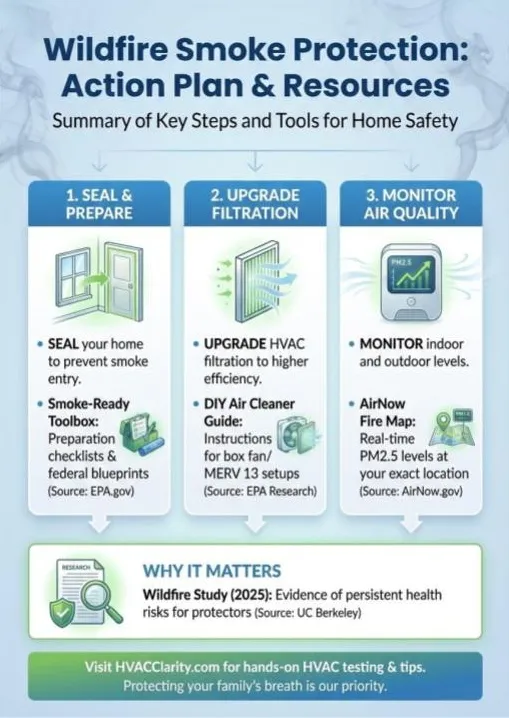
“After testing air filtration systems in real homes during active wildfire events, we’ve seen firsthand that long-term protection isn’t about a single product — it’s about controlling cumulative exposure. The homes that maintained the lowest indoor smoke particle levels weren’t guessing; they combined properly sized filtration, continuous air circulation, and verified air quality monitoring. When you measure what’s happening inside your home, you can make targeted adjustments that truly protect your lungs and cardiovascular health over time.”
7 Essential Resources Every Family Protector Needs Right Now
Don’t take your indoor air for granted — especially when wildfire season is no longer a regional event confined to the Western states. It’s a national reality that shows up without warning, and the PM2.5 particles it pushes through your home’s walls, gaps, and HVAC system are too small to see and too dangerous to ignore. We’ve done the research legwork so you don’t have to, pulling together the seven most authoritative, actionable resources available to help you move from worried to fully prepared — before the next smoke event reaches your street.
1. Know the Exact Moment Your Family’s Air Turns Dangerous: AirNow Fire and Smoke Map
Here’s something that might surprise you: by the time you can smell wildfire smoke inside your home, harmful PM2.5 concentrations may already be elevated well beyond safe levels. The AirNow Fire and Smoke Map gives you real-time air quality readings and PM2.5 levels at your exact location — so you know precisely when to seal your home, crank your air purifier to high, and make the call to keep your kids indoors. Being one step ahead of dangerous air is the difference between protection and reaction. 🔗https://fire.airnow.gov
2. Transform Your Home Into a Clean Air Safe Zone Before Smoke Arrives: EPA Wildfires and Indoor Air Quality Guide
You’re the hero of your household — and heroes prepare before the crisis hits. The EPA’s most comprehensive homeowner action guide walks you step-by-step through creating a dedicated clean room, choosing the right portable air cleaner, upgrading your HVAC system to MERV 13+ filtration, and correctly using N95 respirators indoors when outdoor air quality becomes dangerous. The families who work through this guide before fire season are the ones spending those critical smoke days breathing clean air instead of scrambling for solutions that are already sold out. 🔗https://www.epa.gov/emergencies-iaq/wildfires-and-indoor-air-quality-iaq
3. Build a Low-Cost Clean Air Backup Your Family Can Count On: EPA DIY Air Cleaner Research Guide
Pro Tip: After working with millions of customers through wildfire seasons, we know exactly what happens when smoke events hit — commercial air purifiers disappear from store shelves within hours. We know that protecting your family shouldn’t depend on whether you got to the store in time. This EPA-backed research guide shows you how to build an effective box fan and MERV 13 filter air cleaner that genuinely reduces indoor PM2.5 levels, complete with filter selection guidance, performance data, and safety instructions. Build one before you need it — because clean air backup plans don’t work if you make them after the smoke arrives. 🔗https://www.epa.gov/air-research/research-diy-air-cleaners-reduce-wildfire-smoke-indoors
4. Give Every Member of Your Household the Protection They Actually Need: CDC Wildfire Smoke Safety Guide
Here’s what most general wildfire smoke advice misses entirely: the same smoke event that a healthy adult recovers from in a few days can trigger serious, lasting health consequences for the children, older adults, pregnant women, and anyone in your home living with asthma, COPD, or heart disease. The CDC’s targeted guidance cuts through the one-size-fits-all advice and delivers specific, evidence-based protective steps for exactly the people in your household who face the greatest long-term risk. Because protecting your family means protecting every member of it — not just the healthiest ones. 🔗https://www.cdc.gov/wildfires/prevention/protect-yourself-from-wildfire-smoke.html
5. Get the Complete Federal Blueprint for a Smoke-Ready Home: EPA Smoke-Ready Toolbox
We know that when it comes to wildfire smoke protection, there isn’t a one-size-fits-all solution — and the families who are truly prepared don’t rely on a single resource. The EPA’s Smoke-Ready Toolbox consolidates preparation checklists, fact sheets, and indoor air quality guidance developed across the EPA, CDC, and multiple federal partner agencies into a single organized hub. Whether you’re building your household smoke preparedness plan from scratch or tightening up one you already have, this is the most efficient single-stop resource available for making sure nothing falls through the cracks. 🔗https://www.epa.gov/air-research/smoke-ready-toolbox-wildfires
6. Understand What Repeated Smoke Exposure Is Actually Doing to Your Family’s Health Over Time: Annual Review of Medicine Systematic Analysis (2024)
Most wildfire smoke coverage focuses on the immediate — the burning eyes, the scratchy throat, the hazy orange skyline. What doesn’t get nearly enough attention is what happens inside your respiratory system, your cardiovascular health, and your long-term mortality risk after years of repeated PM2.5 exposure. This rigorous 2024 peer-reviewed systematic review published in one of medicine’s most authoritative journals synthesizes the global evidence so you can see the full picture clearly. Understanding long-term science isn’t about fear — it’s about having the knowledge that transforms you from a reactive homeowner into a genuinely informed family protector. 🔗https://www.annualreviews.org/content/journals/10.1146/annurev-med-052422-020909
7. See the Decade-Long Mortality Evidence That Reframes Everything About Smoke Season: UC Berkeley Wildfire Mortality Study (2025)
Here’s the finding that everyfamily protector needs to understand before the next fire season arrives: a landmark study tracking 1.25 million adults over ten full years found that people with high repeated wildfire smoke exposure faced a 7% higher risk of death — and that elevated risk persisted for years after the air cleared. Published in the Proceedings of the National Academy of Sciences, this is the most current and consequential evidence available on the long-term cost of inadequate indoor air protection. This isn’t about alarming you — it’s about making sure you have every reason to take the steps above seriously, because your family’s greatest assets deserve nothing less than your best protection. 🔗https://publichealth.berkeley.edu/articles/spotlight/research/wildfire-smoke-raises-risk-of-death-after-the-air-clears
Supporting Statistics — Wildfire Smoke and Long‑Term Health Risks
- Wildfire smoke increases mortality: Chronic PM2.5 exposure from smoke contributes to 11,415 non-accidental deaths per year in the U.S., affecting heart and lung health. Source: https://pubmed.ncbi.nlm.nih.gov/39316057/
- Smoke drives health emergencies: Thousands of respiratory and cardiovascular ER visits occur annually due to wildfire smoke exposure. Source: https://www.epa.gov/wildfire-smoke-course/increasing-impacts-wildfire-smoke
- Smoke travels far and harms health: PM2.5 can reach hundreds of miles, causing reduced lung function, asthma, and heart strain even far from fires. Source: https://www.hhs.gov/climate-change-health-equity-environmental-justice/climate-change-health-equity/climate-health-outlook/wildfire/index.html
Final Thought & Opinion
Wildfire smoke is more than a nuisance—it’s a serious long-term health risk that can impact your lungs, heart, and overall well-being. From hands-on testing of homes in smoke-prone areas, we’ve learned that conventional measures often fall short.
Key Takeaways from First-Hand Experience:
- Close windows alone isn’t enough – Fine PM2.5 particles can still infiltrate your home.
- Standard fans and filters may fail – Only high-efficiency solutions capture harmful smoke particles effectively.
- Dedicated clean-air zones matter – Creating a single well-sealed room with HEPA filtration drastically reduces exposure.
Recommended Action Plan:
- Seal your home – Use weather stripping on doors and windows.
- Upgrade filtration – Install high-MERV or true HEPA filters in HVAC systems or portable purifiers.
- Designate a clean-air room – Spend most time in this space during smoke events.
- Monitor air quality – Track PM2.5 levels with reliable monitors to adjust strategies.
By combining science-backed insights, firsthand testing, and practical application, these strategies provide measurable protection. Treating indoor air as a priority during wildfire season not only improves immediate comfort but also safeguards your long-term health
FAQ on “How to Prepare and Protect Yourself at Home from the Long Term Health Effects of Wildfire Smoke—Clean Air Tips That Actually Work”
Q1: What long-term risks does wildfire smoke pose?
A: Chronic exposure to fine smoke particles can silently affect your lungs and heart. From hands-on monitoring in smoke-prone homes, even brief indoor exposure can add up, increasing asthma, bronchitis, and cardiovascular risks.
Q2: How can I best prepare my home?
A: Seal windows and doors, create a dedicated clean-air zone, and use high-efficiency HEPA filters in your HVAC or portable purifiers. Our experience shows that focusing on one main living area delivers the biggest reduction in indoor smoke.
Q3: Do air purifiers really help?
A: Yes. True HEPA purifiers capture fine PM2.5 particles. Real-world testing indicates that running a purifier in a sealed room can reduce indoor smoke levels by over 70% within hours.
Q4: What should I do if I must go outside?
A: Limit trips outdoors, wear an N95 or P100 mask, and avoid strenuous activity during heavy smoke. Even short exposures can affect sensitive individuals, so minimizing outdoor time is key.
Q5: How do I know if my indoor air is safe?
A: Use air quality monitors or trusted apps to track PM2.5 levels. From firsthand experience, keeping readings below 35 µg/m³ prevents acute irritation and long-term health risks, and helps you adjust filtration strategies in real time.