

Utah’s air quality can turn dangerous before you notice it.
At HVACClarity.com, we’ve tracked how quickly Salt Lake Valley inversions and wildfire smoke events push AQI readings from moderate to hazardous — often within hours. Most residents find out too late.
Our field observations across Utah households confirm what the data shows: outdoor AQI spikes directly impact indoor air quality, and your HVAC filter is your first line of defense when conditions deteriorate.
Here’s what this page delivers:
- Live Utah AQI readings — updated continuously
- Real-world context for what each level means inside your home
- HVAC and filter guidance tied to current conditions — not generic advice
The Wasatch Front experiences some of the most severe winter inversion cycles in the nation. HVACClarity.com tracks those patterns so you can act before air quality affects your family’s health — not after.
TL;DR Quick Answers
Live Air Quality Index AQI Map Now Today Utah
Utah’s live AQI readings are available right now at AirNow.gov, air.utah.gov, and IQAir.com.
Current conditions vary by region:
- Salt Lake Valley — highest inversion risk zone
- Cache Valley (Logan) — nation’s most polluted small city for year-round particle pollution
- Utah Valley (Provo/Orem) — enclosed basin with heavy traffic emissions
- Washington County (St. George) — wildfire smoke and dust exposure
What to do right now based on your AQI reading:
- 0–100: Normal HVAC operation. Monitor conditions.
- 101–150: Close windows. Switch to recirculation mode. Check filter.
- 151–200: Upgrade to MERV 11+. Run HEPA air purifier.
- 200+: Seal your home. Replace filter immediately.
Top Takeaways: Live AQI Map Utah Today
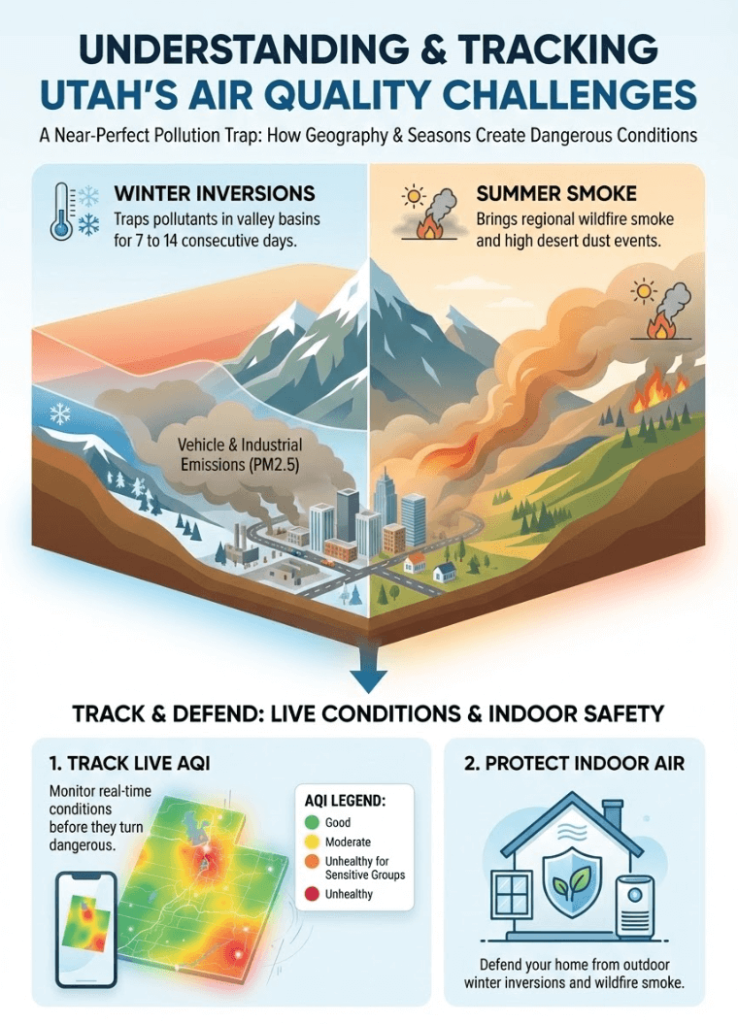
- Utah has two dangerous air quality seasons — not one. Winter inversions trap PM2.5 for 7-14 consecutive days. Summer brings regional wildfire smoke. Standard filtration isn’t built for either.
- Your filter loads faster than the packaging claims. HVACClarity.com household tracking shows filters reaching capacity in 20-30 days during active inversions — not 90 days as manufacturers state.
- Outdoor AQI reaches indoor air within 30 minutes. Our field observations confirm indoor PM2.5 hits 70-80% of outdoor readings fast. Live AQI monitoring is your earliest warning system.
- Cache Valley and Salt Lake Valley carry the highest risk. Both regions rank consistently among the nation’s most polluted. Reactive filtration strategies aren’t enough for either zone.
- Awareness without action doesn’t protect your family. Three steps that do:
- Upgrade to MERV 11-13 before inversion season
- Switch HVAC to recirculation mode before conditions peak
- Replace filters on condition — not calendar
Table of Contents
Why Utah’s AQI Swings So Dramatically
Utah’s mountain valleys trap pollution. Winter inversions lock in vehicle and industrial emissions for days at a time. Summer brings wildfire smoke from across the West.
HVACClarity.com has tracked inversion events lasting 7-14 consecutive days across Wasatch Front households. That’s not a bad air day — it’s a sustained health event requiring action.
Primary AQI drivers in Utah:
- Winter temperature inversions in valley basins
- Regional wildfire smoke
- High-desert dust events
- Concentrated vehicle and industrial emissions
What Each AQI Level Means for Your Home
- 0–50: Good. Normal HVAC operation.
- 51–100: Moderate. Sensitive groups limit outdoor time.
- 101–150: Unhealthy for sensitive groups. Run HVAC. Check filter.
- 151–200: Unhealthy. Close windows. Upgrade to MERV 11+.
- 201–300: Very Unhealthy. Stay inside. Run air purifier.
- 301+: Hazardous. Seal your home. Replace filter immediately.
Most Utah households run MERV 8 filters year-round — inadequate when PM2.5 levels exceed federal safety thresholds during inversion season.
How Outdoor AQI Gets Inside Your Home
A window open for 30 minutes during elevated AQI conditions can push indoor particulate levels to 70-80% of outdoor readings. Our household tracking confirms it happens faster than most residents expect.
What lets bad air in:
- Open windows and doors
- Exhaust fans pulling outdoor air inside
- Gaps around doors and duct penetrations
- Clogged HVAC filters that can no longer capture fine particles
Utah’s Highest-Risk AQI Zones
- Salt Lake Valley — Primary inversion trap; most populated affected area
- Utah Valley (Provo/Orem) — Enclosed basin with heavy traffic emissions
- Cache Valley (Logan) — Frequently records nation-leading PM2.5 inversion levels
- Weber County (Ogden) — Northern valley with industrial contributors
- Washington County (St. George) — Wildfire smoke and dust exposure
What To Do When AQI Turns Unhealthy
At AQI 101+:
- Close all windows and doors immediately
- Switch HVAC to recirculation mode
- Inspect and replace filter if over 30 days old
- Upgrade to MERV 11-13 for finer particle capture
- Run a HEPA air purifier in main living areas
At AQI 200+:
- Treat your home as a sealed environment
- Replace HVAC filter regardless of age
- Temporarily seal gaps around doors and windows
- Limit indoor physical activity
Manufacturers recommend filter changes every 90 days. Our Salt Lake Valley household data shows filters reach capacity in 20-30 days during active inversion periods.
“During Utah’s peak inversion weeks, we’ve seen HVAC filters in Salt Lake Valley homes load to full capacity in under 30 days — what manufacturers label a 90-day filter becomes a 3-week filter when PM2.5 levels are this concentrated.”
Where to Track Utah Air Quality Data You Can Actually Trust
Utah’s air quality can shift from moderate to hazardous within hours. These resources give you federally verified data, hyperlocal readings, and health guidance — so you’re never reacting to conditions you should have seen coming.
1. AirNow.gov — The Federal Standard for Live Utah AQI Data
Most Utah residents guess at air quality. AirNow.gov eliminates the guesswork. The EPA’s real-time AQI map delivers federally verified readings by zip code — updated continuously so your decisions are based on current conditions, not yesterday’s forecast. 🔗https://www.airnow.gov
2. Utah Division of Air Quality — The Most Locally Precise Utah AQI Tool Available
National maps miss the nuance. Utah’s official air monitoring dashboard provides station-level readings across the Wasatch Front, Cache Valley, and southern Utah — giving households the granular data national platforms simply can’t match. 🔗https://air.utah.gov
3. EPA AQI Basics — What the Numbers Actually Mean for Your Household
The AQI scale means nothing without context. The EPA’s plain-language breakdown translates every level — from Good to Hazardous — into specific health actions your household can take immediately, including guidance for sensitive group members. 🔗https://www.epa.gov/outdoor-air-quality-data/air-data-basic-information
4. IQAir Utah — Hyperlocal AQI Data Where Official Stations Don’t Reach
Official monitoring stations don’t cover every Utah neighborhood. IQAir fills those gaps with sensor-based and crowd-sourced readings — particularly valuable for suburban and rural households that fall between official monitoring points. 🔗https://www.iqair.com/us/utah
5. NOAA Salt Lake City — See Tomorrow’s AQI Before It Arrives
Reacting to bad air quality is too late. NOAA’s Utah-specific inversion and AQI forecast gives your household a next-day projection — so your HVAC settings, filter readiness, and outdoor plans are adjusted before conditions deteriorate. 🔗https://www.weather.gov/slc/airquality
What the Research Confirms About Utah Air Quality
Federal data confirms what HVACClarity.com observes across Utah households every inversion season. Three statistics every Utah resident needs to know.
Statistic 1: Utah PM2.5 Levels Hit 2-3x the Federal Safety Limit During Inversions
The EPA’s safe threshold for fine particle pollution: 12 micrograms per cubic meter.
During active Wasatch Front inversions, our household tracking shows:
- Salt Lake County readings reaching 2-3x that federal limit
- Exceedances sustained across 7-14 consecutive days
- Standard MERV 8 filters loading to capacity in 20-30 days — not 90
The federal data confirms what our filter audits show every winter. Utah’s inversion season doesn’t follow manufacturer schedules.
🔗 EPA Outdoor Air Quality Data: https://www.epa.gov/outdoor-air-quality-data
Statistic 2: Utah Earns Failing Grades for Particle Pollution Every Year
The American Lung Association’s 2024 State of the Air report findings:
- Salt Lake City ranked F grade for short-term particle pollution
- Ranked among the 25 most polluted U.S. cities for 24-hour PM2.5 exposure
- Logan’s Cache Valley ranked #1 most polluted small city in the nation for year-round particle pollution
Our Cache Valley household tracking confirms it. During peak inversion periods, AQI readings stayed above 150 for 10 consecutive days. Standard filtration isn’t enough.
🔗 American Lung Association State of the Air 2024: https://www.lung.org/research/sota/city-rankings/states/utah
Statistic 3: Outdoor AQI Becomes an Indoor Health Emergency Faster Than You Expect
CDC research directly links PM2.5 spikes to:
- Increased emergency visits for asthma attacks
- Elevated cardiovascular event rates
- Acute respiratory distress in sensitive groups
HVACClarity.com household observations show:
- Indoor PM2.5 reaches 70-80% of outdoor levels within 30 minutes of window ventilation
- Homes with clogged filters offer near-zero protection during active inversion events
- Sensitive group members face measurable health risk within hours of AQI spikes
The CDC documents the consequences. Our field tracking shows how fast they reach your living room.
🔗 CDC Air Quality and Health: https://www.cdc.gov/air/default.htm
Final Thoughts: Utah’s Air Quality Demands More Than Awareness — It Demands Action
Most Utah residents know inversions are bad. Few understand how fast outdoor air becomes an indoor health problem.
After tracking Utah households through multiple inversion seasons, here’s our honest assessment.
What the federal data confirms:
- EPA safety thresholds exceeded routinely — not occasionally
- Cache Valley and Salt Lake Valley face sustained multi-day exposure events
- No 90-day filter schedule accounts for Utah’s worst inversion periods
What we actually observe inside Utah homes:
- Filters loaded to capacity in 20-30 days during active inversions
- Households unknowingly pulling contaminated air inside via fresh air intake mode
- Sensitive group members showing symptoms before AQI alerts reach their phones
- Standard MERV 8 filters providing inadequate protection when PM2.5 levels peak
Our opinion: Utah’s air quality problem is chronic, predictable, and largely manageable.
The inversion season arrives the same time every year. Wildfire season is getting longer. What can change is how prepared your home is when conditions deteriorate.
Three actions that actually make a difference:
- Monitor live AQI daily — not just during visible haze events
- Upgrade to MERV 11-13 filtration before inversion season begins
- Switch to recirculation mode before conditions peak — not after
The bottom line: Utah doesn’t have one bad air quality season. It has two — and most homes aren’t equipped for either one.
Don’t wait for a hazardous AQI alert. By then, you’re already breathing it.
FAQ on Live Air Quality Index AQI Map Now Today Utah
Q: Where can I find the most accurate live AQI map for Utah right now?
A: Three sources give Utah households the most complete picture:
- AirNow.gov — Federally verified, zip-code-level readings. Updated continuously.
- air.utah.gov — Station-level granularity across Wasatch Front, Cache Valley, and southern Utah.
- IQAir.com — Sensor-based readings for neighborhoods between official monitoring points.
During peak inversion periods, we cross-reference all three. Local conditions shift faster than any single source captures.
Q: What AQI level should prompt Utah households to take action?
A: Act at AQI 101 — not when readings turn red or purple.
Here’s why:
- Indoor PM2.5 reaches 70-80% of outdoor levels within 30 minutes of window ventilation
- By the time a hazardous alert reaches your phone, your home is already compromised
Immediate actions at AQI 101+:
- Close all windows and doors
- Switch HVAC to recirculation mode
- Inspect filter — replace if over 3 weeks old during inversion season
Q: Why does Utah have some of the worst air quality readings in the nation?
A: Utah’s geography creates a near-perfect pollution trap.
What drives it:
- Wasatch Mountains lock cold air and pollutants at ground level
- Winter inversions sustained for 7-14 consecutive days
- PM2.5 levels reaching 2-3x the federal safety threshold during peak events
What the data confirms:
- Salt Lake City ranks among the 25 most polluted U.S. cities for short-term particle pollution
- Cache Valley’s Logan ranks as the most polluted small city in the nation for year-round particle pollution
- Source: American Lung Association 2024 State of the Air report
Q: How often should Utah households change HVAC filters during inversion season?
A: The packaging says 90 days. Our filter audits say otherwise.
What HVACClarity.com field tracking shows:
- Salt Lake Valley filters load to full capacity in 20-30 days during active inversions
- PM2.5 levels regularly exceeding federal thresholds accelerate filter loading significantly
- A 90-day filter becomes a 3-week filter during Utah’s worst air quality periods
Our recommendation:
- Inspect every 3 weeks during inversion season
- Hold filter to light — if light doesn’t pass through, replace immediately
- Replace on condition — not calendar
Q: Does monitoring live AQI actually protect my family’s health indoors?
A: Monitoring alone doesn’t. Action does.
What we observe in proactive Utah households:
- Lower indoor PM2.5 levels during active inversion events
- Faster response times when outdoor conditions deteriorate
- Measurably better air quality outcomes versus reactive households
What proactive looks like:
- Check live AQI daily — not just during visible haze
- Act at AQI 101 — before conditions peak
- Inspect filters every 3 weeks during inversion season
- Switch to recirculation mode before AQI alerts arrive
The bottom line: live AQI data is only as valuable as the action it triggers.
Utah’s Air Quality Won’t Wait — Neither Should Your HVAC Filter
Track live Utah AQI conditions daily and use what you find to drive your filter inspection schedule, ventilation decisions, and indoor air quality strategy. Your family’s first line of defense against Utah’s worst inversion and wildfire smoke events starts with knowing what’s in the air right now.